Not all veneers are created equal, and neither are the maintenance requirements. Porcelain and composite resin veneers have different strengths and weaknesses. Porcelain is strong because it is essentially a form of fired ceramic.
The surface is glasslike, extremely polished, and contains very little porosity meaning it won’t stain easily and it keeps its color well over the course of time.
On the other hand, composite resin is a plastic-based material, which means it is more prone to staining due to pigmenting substances and it is easier to chip as it is softer than porcelain veneers.
The microscopic roughness of the material attracts the very compounds that can degrade the bond holding the veneer on the tooth. Since the adhesive is what keeps your veneer on your tooth and keeps bacteria and acid from leeching up beneath it and causing decay, this is a pretty critical weak point.
Both composite resin and porcelain veneers are bonded to your natural tooth using a dental bonding agent – an adhesive, specialized resin that chemically unites to acid-etched enamel. The bond is strong but it isn’t bulletproof. The bond is constantly under assault simply because of where it sits but also because people don’t give it the love it needs.
The Toothpaste Problem Most Veneer Wearers Don’t Know About
Whitening toothpastes are promoted as a cosmetic benefit, so they’re an easy go-to for anyone who’s paid for a white smile. For veneer wearers, they’re usually the wrong call.
Most whitening toothpastes work via abrasives. Silica particles. Baking soda. Charcoal. At the levels needed to have an appreciable effect on natural enamel, these are unsafe for your polished porcelain and even worse for your composite resin. That tiny hive of brush bristle activity creates micro-scratches in the glossy surface of your veneer.
Though invisible at first, these scratches accumulate. The sparkle that makes a good veneer look like a real tooth is in the polish, and those scratches dull it. The jagged ridges left by the abrasives turn your veneer into a pigmented particle magnet. Soon you have a dull and increasingly stained veneer.
Use a non-abrasive toothpaste. Most fluoride toothpastes that don’t claim extra-whitening effects are safe. For patients considering Veneers Cannington, this is one of the first things a good cosmetic dentist will tell you. Check the label. If it says “whitening,” “polishing,” or if it contains baking soda or activated charcoal, put it back on the shelf. It’s not for you.
Why Bruxism Is The Single Biggest Threat To Your Investment
Grinding your teeth, or bruxism, is one of the top reasons veneers fail prematurely. When you’re asleep and grinding away, you can exert hundreds of pounds of pressure per square inch on the surfaces of your teeth. Veneers are strong but they’re not that strong.
They can’t take that kind of pressure indefinitely. And the lateral, back-and-forth grinding is stressing the bond between natural teeth and veneers at a microscopic level that, over time, can weaken and break.
Porcelain is resistant to the direct compressive forces of normal biting but the lateral forces generated by grinding can snap it like a twig. Composite handles stress somewhat differently, but it chips and wears under the same obsessively repeated shearing as porcelain breaks. Neither nearly performs as well as they should when bruxism is involved.
The solution is to manage the bruxism. Over-the-counter nightguards from the pharmacy don’t offer enough protection because they don’t fit well enough to evenly distribute the grinding force. A custom-fabricated occlusal splint does.
It’s made from a mold of your teeth and it’s created to the exacting specifications necessary to position and absorb bruxing forces before they damage your gorgeous new restorations. If you know you grind or if your dentist has ever pointed out wear patterns on your teeth to you, get a nightguard before you get veneers. Not after.
The Margin: Where Decay Can Still Happen
It’s important to clarify that the veneer itself is not prone to decay. It’s ceramic or resin. There’s no tooth structure in it to break down. But the natural tooth that it’s bonded to is still fully capable of getting a cavity.
The margin – the microscopic line where the edge of the veneer meets your natural tooth at or near the gumline – is where things get dicey. If plaque is allowed to accumulate there, bacteria find their way into any minuscule crevice between the veneer and the enamel.
This is called marginal leakage, and the decay that forms underneath the restoration eats away the bond and, eventually, the tooth structure that supports the veneer.
Gingival recession makes this all worse. As gums recede, the margin of the veneer is laid bare, creating a visible line and an avenue for bacteria that didn’t previously exist when the veneer was placed. The best defense against both is meticulous gum health. Periodontitis creates exactly the conditions that shorten veneer longevity.
Flossing is important here, but so is technique. You don’t want to shoot the floss upward into the gumline, where it can catch on a veneer margin. Instead, guide it downward from the contact point between the teeth and gently submerge it below the gumline in a C shape. It takes a few extra seconds and drastically lessens the edge-of-the-restoration mechanical strain.
Dietary Habits That Cause Physical Debonding
Foods that are most damaging to veneers are usually hard foods that take a lot of biting force. E.g. biting into a whole apple, snapping off a piece of crusty bread, or crunching into raw carrots. These types of food give lateral shearing force to the bonding interface. That means, you’re much more likely to pop the veneer off your tooth.
Eating hard foods isn’t bad for you – as long as you cut them into pieces first. It’s still possible to eat the same foods, but by removing the how-you’re-doing-it, it won’t stress your teeth as much. E.g. the apple is fine when it’s sliced. The bread is fine when it’s torn into smaller pieces (try resting these on the back teeth). It’s a small compromise to alleviate a major stress on your bonding interface.
Also, don’t use your teeth as a universal tool. Nails, pen caps, packaging. Any of these will transfer irregular force loads to your veneer which is sealed, not designed to cope with them.
Cleaning Protocols That Protect The Bonding Agent
Most veneer wearers should stop using alcohol-based mouthwashes. The solvent risk arises from chronic exposure to alcohol; repeated short baths in alcohol are unlikely to cause issues. But alcohol-based mouthwashes should not be part of your everyday battery of dental products.
The constant softening effect of alcohol on the composite bonding resin could lead to degrading the properties of the adhesive interface over time between the veneer and the tooth.
None of this is to say that mouthwashes aren’t worth it. On the contrary, they might well be beneficial. But there’s little advantage in using a mouthwash with alcohol just for the sake of it.
There are viable antimicrobial alternatives out there that won’t carry a solvent risk to bonding agents: do some shopping and switch to an alcohol-free formulation. You get the antimicrobial benefit without the chemical degradation risk.
Smoking affects veneers in two ways. Composite resin stains significantly from tobacco exposure – porcelain less so, but composite veneers will discolor. Beyond aesthetics, smoking is one of the leading contributors to periodontal disease, which compromises the gum and bone support that healthy veneers depend on. Chronic alcohol consumption has a similar dual effect: it’s both a direct solvent risk to bonding agents and a risk factor for poor oral health overall.
What Professional Maintenance Actually Looks For
Regular dental checkups play a different role for people who have veneers compared to those who don’t. Your dentist is not only looking for cavities and providing a standard cleaning but also mechanically inspecting the restoration.
Prophylaxis paste, fine enough not to dull the veneer glaze, is an important part of your cleaning. A rough paste can cause damage, similar to abrasive toothpaste. Experienced hygienists, who regularly work with veneers, know how to use a non-scratching paste and avoid putting ultrasonic scaling tools on the veneer surface, which can lead to ceramic fractures.
The signs they are looking for include micro-leakage at the margins, early debonding, changing color or texture that may indicate resin deterioration, and any wear patterns that might show that bruxism is occurring, even in patients who are unaware of it.
Treating Veneers As The Long-Term Investment They Are
Most people spend thousands on veneers and relatively little time thinking about what keeps them intact for the next fifteen years. The material science isn’t complicated once you understand it: porcelain and composite behave differently, bonding agents have chemical vulnerabilities, and margins are the weak point where biological and mechanical threats converge.
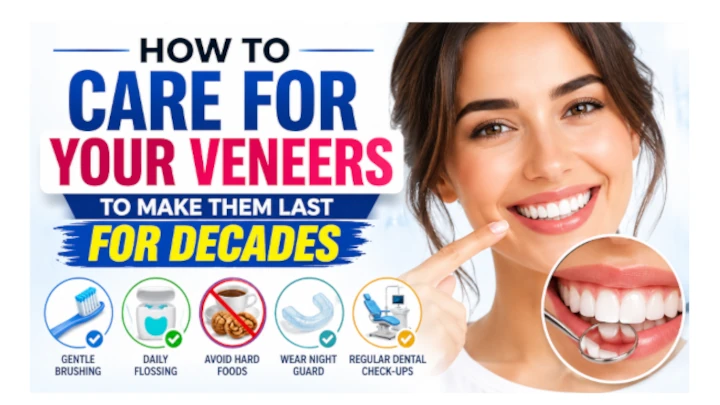
The habits that protect veneers aren’t especially demanding. Non-abrasive toothpaste, controlled biting technique, a nightguard if you grind, alcohol-free mouthwash, and twice-yearly professional cleanings with a dentist who knows what to look for. None of it is difficult. It just has to be consistent – because veneer care isn’t something you do when something feels wrong. By then, the damage is already done.